Riding Indoors
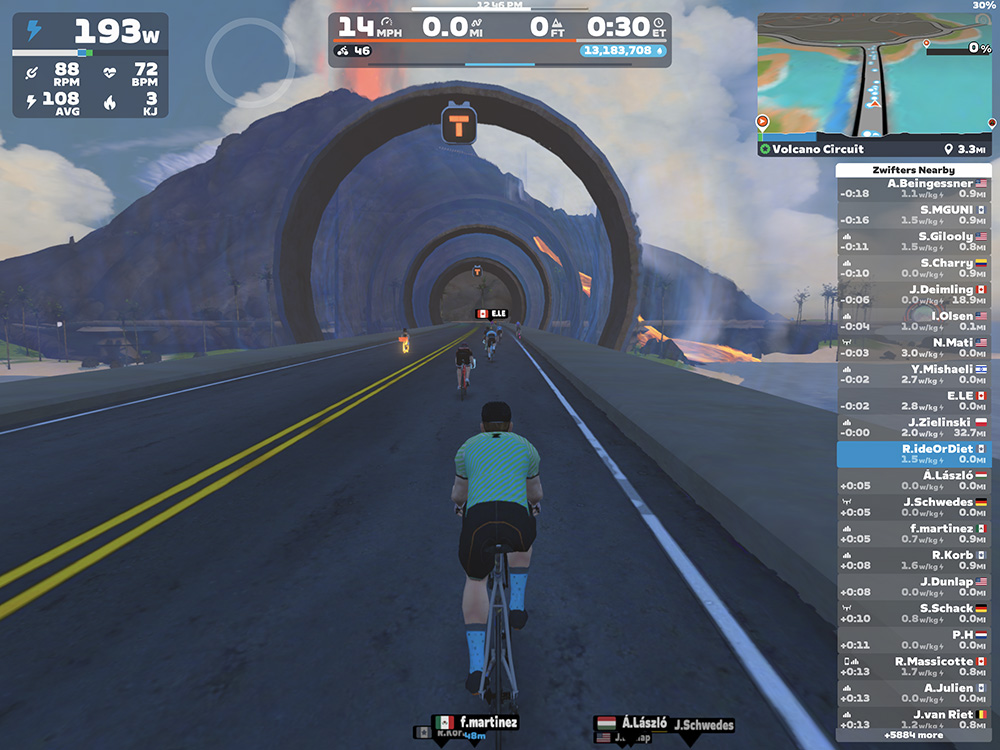
I encourage everyone to get outside on a bike and have some fun. Even in bad weather–a ride splashing around in the mud can be such a laugh (with the right gear). But what if you’d prefer to turn your bike into a torture device inside your house? That is how a lot of cyclists see indoor cycling, but I’m here to say it doesn’t have to be that way.
If the motivation to brave the cold is low, your free time is limited, or you want an outlet for some exercise, an indoor bike can be a great option. Indoor riding has come a long way from the days of grinding away on a set of rollers staring at a wall. There’s virtual worlds for you to explore, along with coached workout programs.
What you need:
A brand new Fairdale, of course! Though, to be honest, pretty much any bike will work. It can be the bike you ride all the time, or your indoor bike can be a mix of spare parts and on whatever old frame (my dedicated indoor bike doesn’t even have brakes).
To get pedaling inside your house, you either need a really big house or a bike trainer (a device that converts your bike into a stationary bike trainer). Smart trainers have revolutionized indoor riding by making pedaling in place less boring.
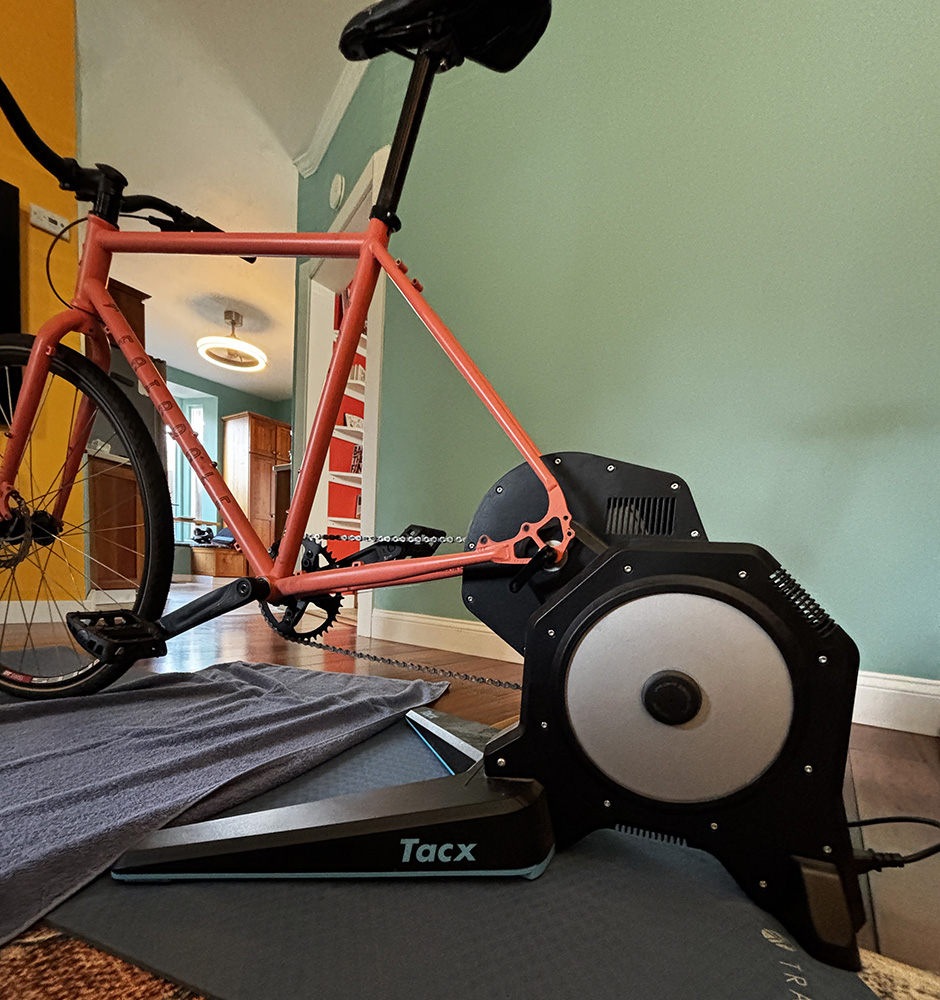
Smart trainers sync with various apps that can vary the resistance and match what you see on your screen to what you feel through your legs. If your onscreen character is pedaling up a mountain, you’ll feel the resistance increase. If you shift into a lower gear, you’ll feel things get easier.
There are all kinds of smart trainers from loads of different brands. They are mostly broken down into two main kinds: “wheel-on” and “wheel-off”. Wheel-on smart trainers are the least expensive. The device locks onto your back wheel, and your rear tire turns the resistance unit. These units are rather loud as the tread of your tires buzzes along on the resistance roller. If you are going to spend any serious time on your indoor bike, I recommend a wheel-off trainer. You’ll remove your bike’s rear wheel and exchange it for the smart trainer. It’s quick and easy to install your bike, and it’s quiet and stable while you ride. I have the TACX Flux 2 trainer, which I picked up for $499.
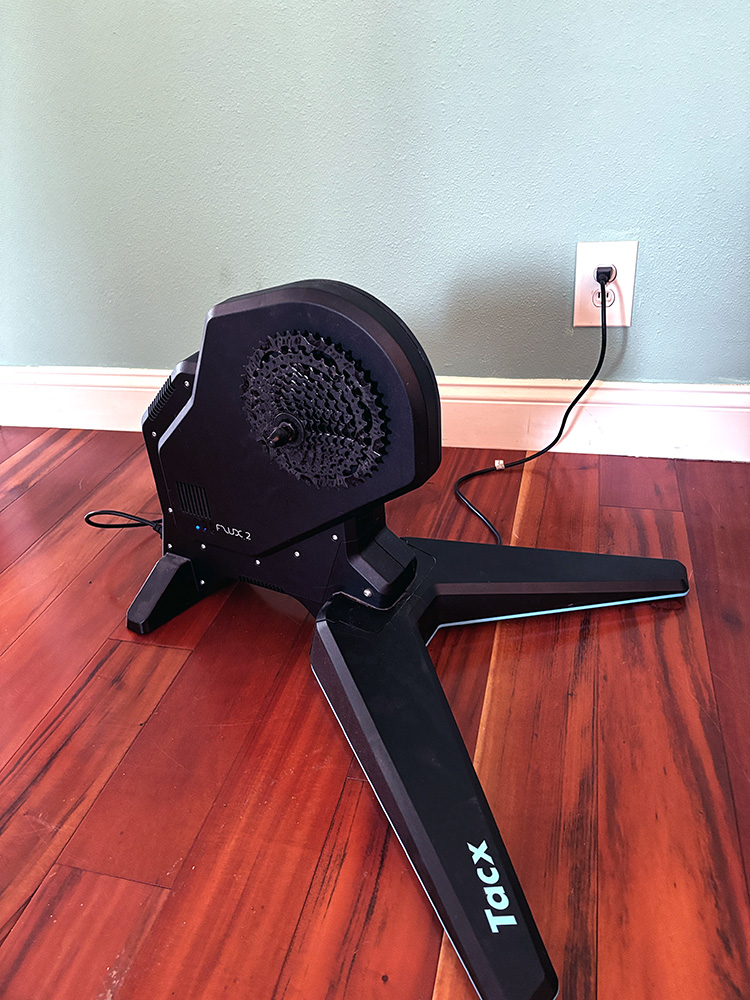
Once your bike is set up on a smart trainer, you need an app to bring it alive. I recommend the Zwift app. There’s a handful of other good ones to check out, but Zwift is the most popular virtual cycling app. The Zwift world is a vast video-game-graphic cycling escape with many different ways to interact with the app.
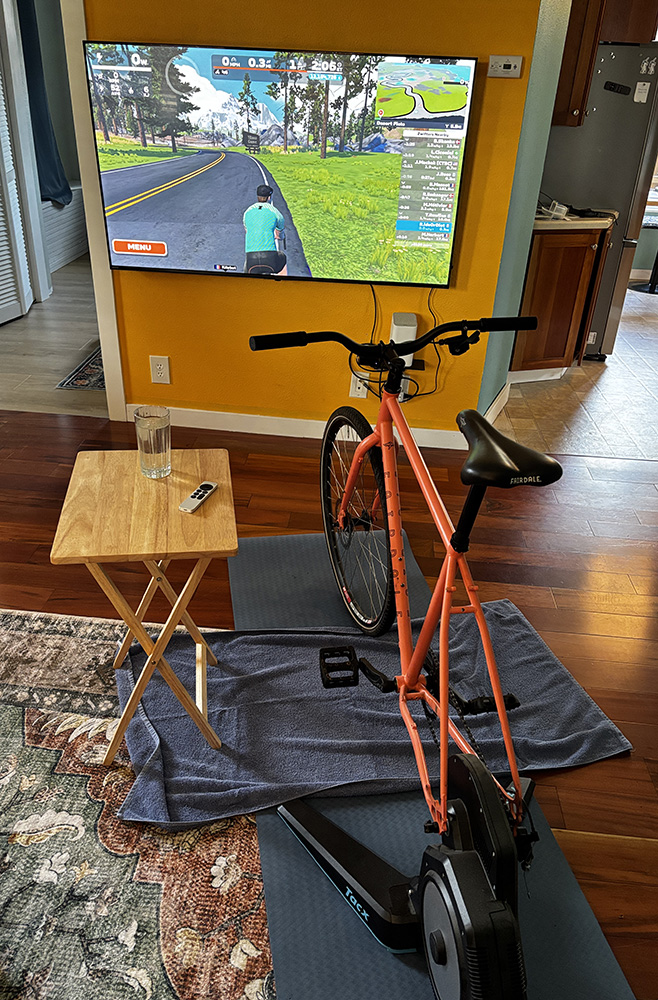
Zwift works on IOS, Android, Mac, and PC. I have mine set up through my Apple TV box and connected to my TV. Once you are signed into Zwift, there are a handful of ways to pedal around inside it. The simplest option is to select a route from the huge library and start pedaling. Free riding around puts the smart trainer into simulation mode. Pedal faster, and you’ll go faster. Your weight, height, and how much power you put through the pedals are used to calculate your virtual speed and the resistance you feel. It ends up feeling like real riding without the worry of having to watch for cars or steer (I agree that steering is one of the fun parts). The other riders you see on screen are real people, presumably with sweat pooling beneath them in their living rooms, too. There’s every kind of route to ride from flat to rolling hills to massive mountains. Some of the routes are full of pretty and fantastical worlds, others are famous cities or well-known Tour de France climbs (Alpe du Zwift is a GPS-accurate replica of Alpe d’Huez that we rode on our Fairdale France trip).
Basically, hop on, pedal around at whatever effort, and for however long you like.
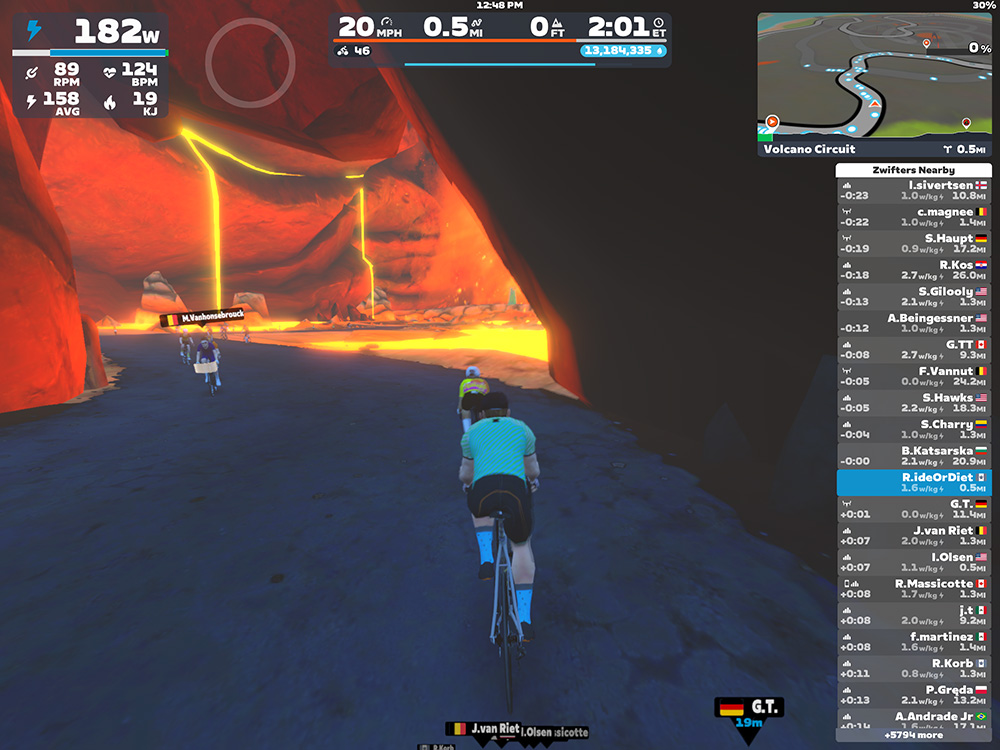
There are virtual races, group rides, and events in the game. On screen, you’ll see the other riders around you, as well as an extensive array of cycling metrics: how much power you are generating with your legs, your speed, the percentage grade of the road you are on, and many more. After a few months of using Zwift, I bought a Garmin heart rate monitor, which also shows up on screen. None of this is essential in any way; they’re just options to keep pedaling without-actually-going-anywhere interesting. It can be motivating to try to maintain a specific power output for a few minutes or beat N.erdyCyclist43 to the top of that hill.
There’s also a library of workouts to choose from. To use these, you take an FTP test inside Zwift to set a benchmark for your fitness. The workouts are then customized to you and will eventually adjust as you get stronger on the bike. Do one at a time, or sign up for a multi-week program.
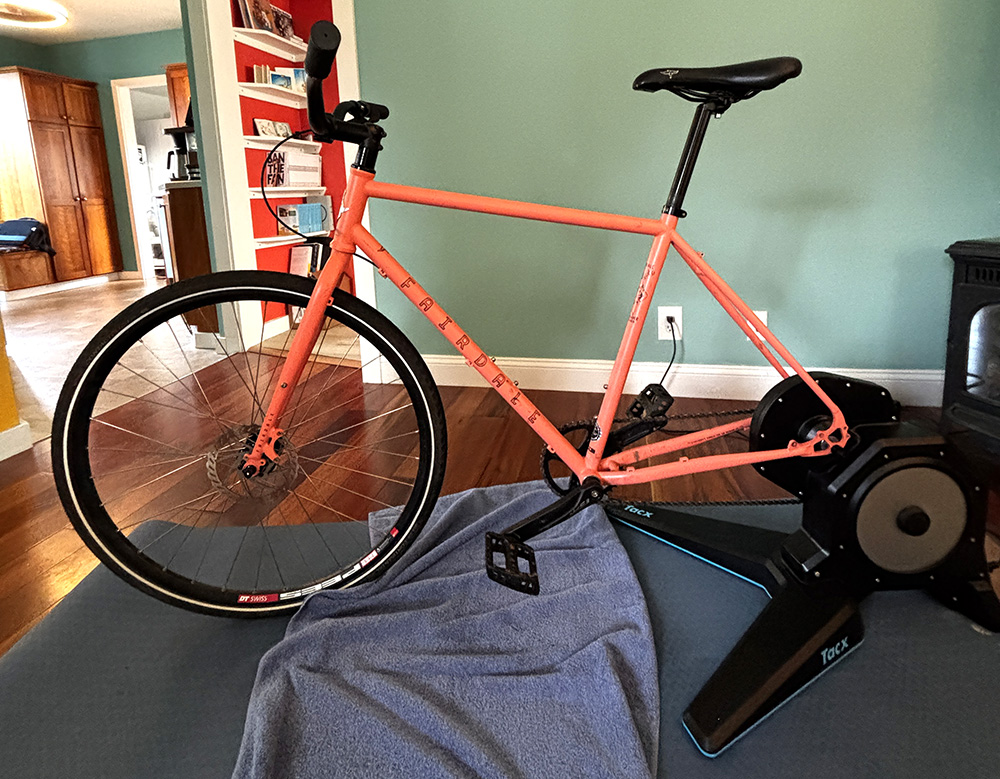
I almost always have an extra bike permanently mounted onto my smart trainer, ready to ride. I’d of course prefer to ride outside, but there are plenty of times where it’s just too cold and rainy to find the motivation to get out there. Other times, my day gets busy, and I just want an easy way to squeeze in some exercise. With Zwift, I can be on the bike and sweating for a quick 30-minute spin as fast as I can throw on some shorts and hop on my bike.
-Taj